

This town with its truly medieval setting has a long history.
There was a Celtiberian castro on this hill and many other peoples also lived here, including Phoenicians, Moors, Romans and, of course, many queens. Maybe the queens were the inspiration for the beauty and romanticism that we can still sense in this delightful town.
The citadel, once given by King Dinis to Queen Isabel, is protected by 14th-century granite walls.
The narrow and winding cobbled streets offer different views at every turn. The houses are whitewashed with traditional coloured bands around doors and windows. Flowers are always present in this charming town, climbing walls and tumbling from the many pots decorate the houses.

In Óbidos, great care is always taken to preserve its historical heritage. There is a feeling that the contemporary does not clash with the past, but instead pays tribute to it and enhances it. Tourism here is of great importance, as the town is one of the most popular attractions in Portugal.
Visiting this town is a pleasure, an exercise in enchantment. Let us enter the town through the Porta da Vila gate, built by João IV and dedicated to Nossa Senhora da Piedade (Our Lady of Sorrows), the local patron saint. Within the gate is an oratory-chapel, a Baroque balcony and a magnificent panel of 18th-century tiles.

We then move on to Rua Direita, from where we can visit the whole town and its monuments.

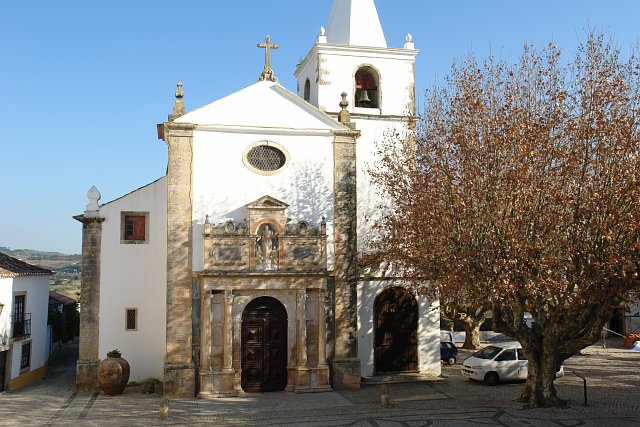
On Praça de Santa Maria, we can find the Telheiro, the old local market. Next to the Telheiro is a Pillory with the royal arms and the shrimping net that was the symbol of Queen Leonor. The church of Santa Maria, the parish church, has a nave flanked by two aisles and prismatic bell tower. In its interior lined with tiles, we can find a carved retable and 17th-century paintings by Baltazar Gomes and Josefa de Óbidos.
In the Castle, classified as a National Monument, there is a Pousada in the converted Paços do Alcaide, which was built in the 16th century and restored after the 1755 earthquake. From the Castle, we have a fine view of the surrounding region. Here, more than anywhere else, we gain a perception of the town’s excellent location, which would have been decisive for its settlement and development since ancient times.
It’s hard to leave…