
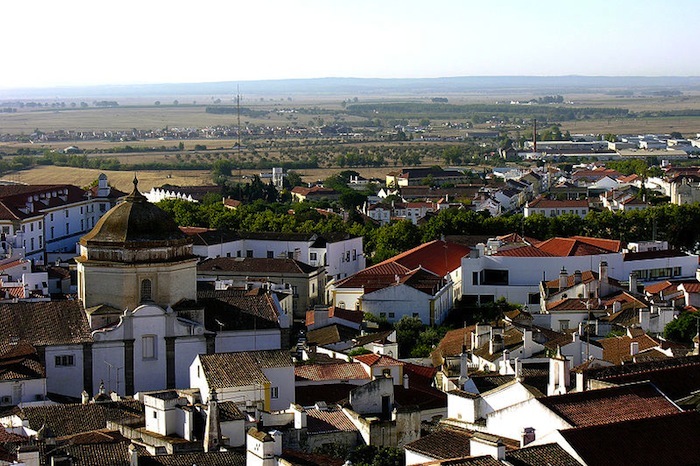
A supreme example of respect for culture, Évora has maintained and preserved vestiges of the civilisations and eras of its past. The city centre, with its rich architecture, has been classified as World Heritage by UNESCO, described it as the “finest example of a city of the golden age of Portugal after the destruction of Lisbon by the earthquake of 1755”.
Wandering through the streets of the historic centre, we come across countless styles that transport us to other eras.
The Temple of Diana, so called because it was believed to have been built in honour of the goddess of hunting, is the most popular of its Roman remains.
Next to it, the Convent of Lóios, a former monastery from the 15th century, is now a welcoming and luxurious hotel. Here guests sleep in monks’ cells that have been carefully renovated and the cloisters are now a wonderful dining room where traditional flavours reflect the rich and varied gastronomy of the region.
Next to the hotel, the Church of Lóios, or of São João Evangelista as it is also known, was built in the Gothic style and in its interior there are 18th-century tiles well worth a visit.
In the same square, the City Museum is housed in a 16th-century palace, the former residence of governors and bishops. Go in and calmly enjoy its collections. From Roman columns to modern sculpture and the wonderful paintings of the painter known in Portugal as Mestre do Sardoal.

A little further on, in Largo do Marquês de Marialva, we can find the Cathedral, a magnificent monument with the grandeur of an veritable fortress, considered one of the most important examples of Gothic architecture in southern Portugal.
Near the front of the Cathedral, down the stone steps to Rua de São Manços, we can admire an elegant Manueline window on the house of Garcia Resende, a Renaissance poet and diplomat. Carved in local marble and granite, it shows clear signs of Mudejar and late-Gothic influences.
Close to the poet’s house we can also visit the Misericórdia church, especially notable for its tile panels from the early 18th century.
And because you are still only half-way through the tour, take a break and visit Praça do Giraldo with its neoclassical and romantic arches and wrought iron balconies. Rest for a while at Café Arcadas while watching the old fountain, built in 1571 in white marble surmounted by a bronze crown.

Once called Praça Grande, this was the centre of the city, the focus of commerce, politics and religion. The first market in Évora, during the reign of King Dinis, took place here.
At the top end of the square is the church of Santo Antão, with frescos that are not to be missed.
Next … Do you want some advice? Just walk around, lose yourself in the streets of this wonderful city and enjoy yourself!
PLACES TO VISIT:
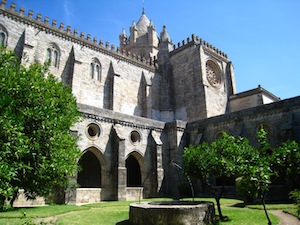
Cathedral:
Its first stones were laid in the late 12th century, but the Cathedral covers several eras and displays several styles resulting in a perfect combination and special elegance. At its main entrance, six archivolts and marble statues of the apostles make this one of the most astonishing Gothic portals in the country.
The Cathedral comprises the cathedral-church itself and a cloister. From the south side we can see the Manueline lantern-tower, the two towers over the main entrance, known as “tower of the tiles” and “clock tower”, and the rose window on the southern transept arm, as well as the chancel. The cathedral plan is a Latin cross, with a nave flanked by two aisles.
Casa de Garcia Resende: The original Manueline window is attributed to Diogo de Arruda, an architect who worked in Évora in the early 16th century. The house, classified as a National Monument, was built around an inner courtyard and has a ground floor and a main floor, with its remarkable window. A third floor, smaller and set back and several terraces complete the building.
